


Plastic Film Recycling Machine
JIANGSU GET RECYCLING TECHNOLOGY CO,.LTD
Original from Europe from 2002, with over 160 plastic recycling projects currently in operation, G.E.T Recycling gives you a clear advice with a tailor made solution on the basis of your plastics and requirements. GET is one of your ideal partners in the field of recycling from beginning of negotiation to seeking for best solutions, and from machines manufacturing to after-sales service.




Why Choose Us
Quality assurance
High efficiency at high capacities, high quality standard recycling plant at Reasonable investment, GET recycling equipment and lines support operational excellence and economic performance for each customer.
Good service
GET is one of your ideal partners in the field of recycling from beginning of negotiation to seeking for best solutions, and from machines manufacturing to after-sales service.
Reasonable price
Demand the highest prices of the end product.
Fast delivery
High efficiency at high capacities, high quality standard recycling plant at Reasonable investment, GET recycling equipment and lines support operational excellence and economic performance for each customer.
Introduction to Plastic Film Recycling Machine
Plastic Film Recycling Machine Designed for flat sheet, stretch film, blown film, thermoforming sheet, breathable film and melt-embossed film in house film recycling, in house film waste including rolls, edge trim, bulk and regrind material is easily recycled.
Small footprint design meant for easy installation and easy integration into existing film production processes. The product line is highly standardized, meaning there are relatively short delivery timeframes.
While being highly standardized, it is still an advanced plastic film recycling machine that delivers consistently high pellet quality. This is in part a result of the Preconditioning Unit which preheats the plastic, significantly reducing the energy input required for plastification in the extruder and the resulting thermo-mechanical stress on the polymer is minimized as a result - a clear increase in quality for the melt and the final recycled pellets.
Can Plastic Film Be Recycled?
How To Recycle Plastic Film
- To recycle plastic film, bring it to one of the 18,000+ drop-off locations across the U.S. and Canada. Many drop-offs are located in supermarkets and other large retail stores.
- Before recycling, make sure the plastic film is clean, dry, and free of food residue. Then, it can simply be placed in any plastic bag recycling bin in a drop-off location.
- Plastic film cannot be recycled from curbside bins because it gets tangled up with other plastics in the equipment at material recovery facilities. This damages the recycling equipment, and the plastic film ends up going to the landfill.
Reading Plastic Film Labels
The Society of the Plastic Industry (SPI)'s classification system can help you sort your plastics.
On your plastic product, look for a number surrounded by the three arrow recycling symbol. Most plastic film is categorized as #2 plastic (high-density polyethylene) and #4 plastic (low-density polyethylene). Only these two types of plastic film can be recycled.
Plastic film that is not categorized as #2 or #4 should be placed in the garbage, as it is important not to contaminate the recycling stream. Unfortunately, if plastic film does not have a label, it must also be placed in the garbage.
What Happens When Plastic Film Gets Recycled?
- During the recycling process, plastic film is brought into the facility in baled form and is then pulled apart by hand or by a guillotine. It is then fed into a shredder and water-fed grinder where it is cut into pieces. The film is then washed and inspected for contamination.
- Once clean and dry, the film is placed into an extruder where heat and pressure melt the plastic. The molten plastic is then released from the extruder, formed into fine strands, cooled, and chopped into pellets. The pellets are used by manufacturers to produce new plastic film products.
- Recycled plastic film is made into composite lumber, which is used for benches, decks, and playground sets. It is also recycled and reprocessed into small pellets that are used to make plastic containers, crates, pipes, new plastic bags, and pallets.
Plastic Film Recycling Challenges
- The effectiveness of plastic film recycling is a subject of debate among many in the industry. Plastic film recycling programs can succeed only if the recycler accumulates large quantities of material to recycle, which is one reason why it's collected at drop-off locations rather than curbside. Large retail stores collect plastic film from consumers and add it to the film generated by their own facility. They accumulate large quantities of it in a short time, which allows them to market full truckloads of film.
- However, many people criticize the store drop-off system as oftentimes the plastic film collected does not end up getting recycled as recycling companies do not have the capacity for it. Therefore, it ends of being sent to the landfill. Additionally, many of the listed store drop-off locations around the U.S. don't actually have a store drop-off system.
- In general, the U.S. only has a 5% processing capacity for plastic films and the majority of the film that is able to be recycled are pallet wraps from retail store sources as they tend to be cleaner. Additionally, the market for plastic film recycling is not ideal as it is much more profitable to make new plastic film rather than recycling old film. The cost to collect, sort, clean, and reprocess old plastic film is 100 times higher than creating new plastic.
What is Film Friction Washer?
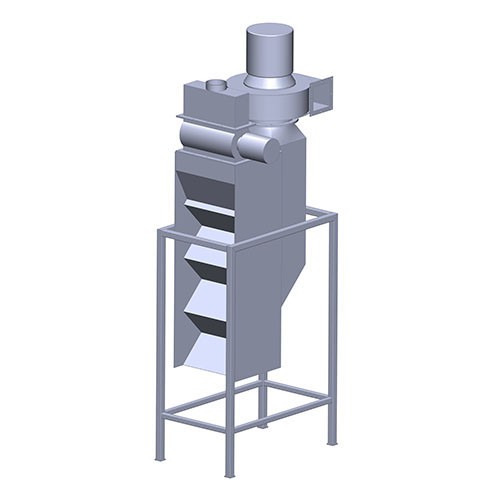
Friction Washer Machine is used to remove dirt and contaminant from plastic flakes and film.
How Film Friction Washer Works?
The main components are the large rotor with several arrays of paddles, dewatering screen and cleaning manifold for water injection. The Friction Washer is accumulated on an inclined frame. The fast-rotating shaft and paddles transport up and hit the materials against the screen, just like how a laundry machine works. Dirt and grease are then driven out of the system, and sprayed away by water nozzles. The dirty water and contaminant then discharge at the bottom of the machine. The cleaned materials leave at the top.
Why it is Important?
Wiscon Friction Washer is commonly used in various applications in industrial processes and the recycling business. Without it, the end product may contain a high portion of contaminants. As a result, the final value of the end-product is low because it contains sands and grease, both of which are dangerous for palletizing and injection molding.
Features of Film Friction Washer?
The friction washer is heavy duty and available in various models, featuring:
No blockage of materials.
Cold wash.
Highly efficient to clean.
Easy maintenance.
Rigorously wash plastic materials.
Compact design comparing water tank.
Applications
Clean highly contaminated materials or big plastic flakes or plastic films which come from a primary shredder or from a crusher. It excels in cleaning agricultural films, rigid plastics, and PET, PP, PE, HDPE flakes.
If your plastic flakes are not heavily contaminated, the flakes are immediately wet washed to obtain clean regrinds. Following by a vertical dryer and an extraction, the regrinds are easily collected, saving your labour costs.

Benefits of the Film Friction Washer
As the world continues to experience the negative impact of plastic pollution, recycling has become a top priority in efforts to reduce waste and minimize environmental damage. More and more countries are implementing policies that support and encourage recycling, and this has created a great demand for recycling equipment, especially in the processing of plastic films.
Our Film Friction Washer is a high-quality system, built to last and withstand the rigors of continuous use. Its construction utilizes the latest technology and innovation, ensuring it is the best in the industry. The system is easy to install and operate, making it a cost-effective solution for any recycling operation.
Benefits of the Film Friction Washer
The Film Friction Washer For Soft Plastic in Plastic Film Recycling Line offers several benefits to those in the recycling industry. These benefits include:
Improved Efficiency - With its unique dynamic friction washing method, our system is able to clean soft plastic more effectively and efficiently than traditional washing systems. This leads to increased productivity and reduced downtime.
Higher-Quality Output - The Film Friction Washer produces a clean, high-quality final product, ideal for reuse in the manufacturing of new plastic products. This helps reduce waste and minimize environmental damage.
Cost-Effective - The system is easy to install and operate, with low maintenance costs, making it a highly cost-effective solution for recycling operations.
Eco-Friendly - The closed-loop water system helps minimize water consumption and waste, making it an environmentally-friendly option for recycling companies.
Film friction washer is used to wash highly contaminated film flakes. They are used for discharging treated material mixed with water from a wet grinder. This also can be used in special cases where the friction washer can be installed in front of or after washing tank.
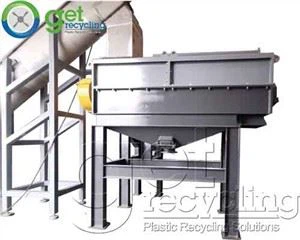
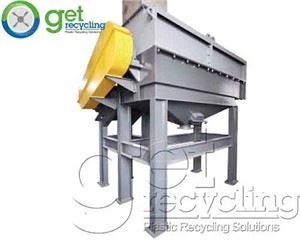
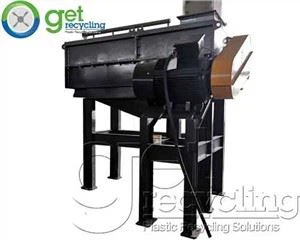
The friction washer consists of a double-walled trough with a fast running paddle rotor to dewater and clean plastic materials (film flakes, granules and similar materials).
The plastic materials with water are fed at the inlet of the trough. The material is washed while being transported to the outlet of the trough. Fines and water are thrown through the screen to the outside while the friction of the paddle rotor cleans the materials.
The centrifuged drain is discharged at the bottom of the trough. The trough is equipped with a removable screen with a stainless screen. A rinsing device ensures the automatic cleaning of the screen and of the inner housing.
Features:
Reinforced and interchangeable rotor in order to guarantee a higher machine quality.
Anti-wear steel for blades of rotor.
Flexibility of the rotor shaft and screen to process the rotor confituration can be changed from washing centrifuge to prewashing centrifuge.
Delicated geometry rotor makes it possible to avoid blockings with medium size pieces.
Self-cleaning system for the screen.
The diameter of the screen holes changes according to the type and degree of the contaminants.
Technical Data
|
Model |
FW6055 |
FW8075 |
FW8090 |
|
Standard capacity |
700kg/hr |
1400kg/hr |
2100kg/hr |
|
Standard motor power |
55kw |
75kw |
90kw |
|
Applicable capacity |
500-900kg/hr |
1000-2000kg/hr |
2000kg-3000kg/hr |
As the world grapples with the growing problem of plastic waste, the need for efficient recycling solutions has never been greater. Polyethylene (PE) film, which is commonly used in packaging and plastic bags, is one of the most prevalent forms of plastic waste. In order to effectively address this issue, it is crucial to implement efficient recycling processes, such as a waste PE film washing line, to ensure that this material can be recycled and reused in a sustainable manner.
Challenges of recycling PE film
Recycling PE film presents several challenges that must be overcome in order to achieve efficient and effective recycling. One of the main challenges is contamination, as PE film is often mixed with other materials such as paper, food waste, and other types of plastic. This contamination can make it difficult to effectively recycle the PE film, as it can negatively impact the quality of the recycled material.
In addition, the sheer volume of PE film waste presents a logistical challenge for recycling facilities. The collection and transportation of large quantities of PE film can be costly and time-consuming, making it essential to implement efficient recycling processes to handle this material effectively.
The benefits of a waste PE film washing line
A waste PE film washing line offers several benefits that can help to overcome the challenges of recycling PE film. By using a washing line, the PE film can be thoroughly cleaned and separated from contaminants, ensuring that the recycled material is of high quality. This not only improves the overall efficiency of the recycling process, but also increases the value of the recycled material, making it more attractive to buyers and manufacturers.
Furthermore, a waste PE film washing line can help to reduce the volume of material that needs to be processed, as the cleaning and separation process can significantly reduce the amount of contaminants that need to be handled. This can help to streamline the recycling process and make it more cost-effective, ultimately making it easier to recycle PE film on a large scale.
Key components of a waste PE film washing line
A waste PE film washing line typically consists of several key components that work together to effectively clean and separate the PE film from contaminants. These components may include:
Shredder: The first step in the recycling process is to shred the PE film into smaller pieces. This not only helps to reduce the volume of material, but also makes it easier to clean and separate the film from contaminants.
Washing tank: The shredded PE film is then placed in a washing tank, where it is agitated and cleaned using water and detergent. This helps to remove any dirt, debris, and other contaminants from the film, ensuring that the recycled material is of high quality.
Friction washer: After the PE film has been cleaned, it is passed through a friction washer, which helps to further remove any remaining contaminants. This step is crucial for ensuring that the recycled material meets quality standards and is suitable for reuse.
Drying system: Once the PE film has been cleaned and separated from contaminants, it is dried using a drying system. This helps to remove excess moisture from the material, making it ready for further processing and recycling.
Our Factory
Original from Europe from 2002, with over 290 plastic recycling projects currently in operation, G.E.T Recycling gives you a clear advice with a tailor made solution on the basis of your plastics and requirements.GET is one of your ideal partners in the field of recycling from beginning of negotiation to seeking for best solutions, and from machines manufacturing to after-sales service.
