Some scientists think that we have over studied the distribution of plastics, but not enough studied its actual harm. The size of the plastic can be a point of entry.

Plastic pollution in Bali
I believe many friends have seen a video of pulling plastic straw out of turtle's nostrils. As a dominant species on earth in the past 40000 years, human beings not only snatch resources and energy from nature through mining, but also transport man-made waste to nature through intentional and unintentional emissions.
Of all the man-made waste, plastic is probably the best known. Recently, an article was published in nature communication, which studied the particle size distribution of plastic ingested by aquatic animals. It was found that the maximum plastic size that animals can ingest is about 20:1 to their own volume.
This study suggests that size should also be taken into account when estimating the risk of plastic contamination.
Size and metabolic rate: the magic three quarters law
The fact that the earth is surrounded by plastic is indisputable. Previously, it was reported that plastic bags and microplastic particles were found at a depth of 10000 meters in the Mariana Trench. There is also a garbage island in the Pacific Ocean, known as the "Eighth Continent", where a large number of plastics and all kinds of household garbage gather and drift around.
Before discussing the specific effects of plastics on various organisms, we review a classic question: the relationship between size and life activities. This helps to understand why we study size, rather than simply saying that the larger the organism is, the larger the plastic it eats.
The creatures on the earth are small as bacteria and large as blue whales, most of which are piled up by cell structure. But if we take cell biology and the external environment as a system, you will find that the contact area between single cell biology and the external environment is the largest, while that of multicellular biology is only the surface contact with the external environment.
Therefore, if the metabolic rate of a single cell is the same, there will be an obvious problem: the specific surface area of multicellular organisms is small and the metabolic heat dissipation is insufficient. (Note: specific surface area, i.e. ratio of total surface area to volume / mass)
If we maintain the same overall metabolic rate as the single cell organism, the larger the size of the organism, the higher the metabolic rate of the single cell must not be too high, otherwise the physical interior of the organism is a high-temperature reactor, and the formation process will be accompanied by implosion.
In fact, previous studies have also found that the larger the body, the slower the relative metabolic rate, and the metabolic rate is related to the power of 3 / 4 of body weight (Kleiber's law).

Kleber's Law: the larger the body, the slower the metabolic rate
This is a very magical fact. According to this law, species a has 10000 times the cell number of species B, but the metabolic rate of species A is only 1000 times that of species B. Therefore, large mammals usually have slower heart rate, longer life span and slower development speed.
But what's interesting is that in fact, all mammals have a lifetime heart rate of one billion times, and the blood pressure is similar. That is to say, when you meet someone who makes your heart beat faster, your body reminds you to cherish the present by burning your life. From the perspective of energy supply, the number of heart beats that can be physically supported by the heart structure is indeed similar.
It can be concluded that the "three quarters law" is a survival strategy developed by different species according to their own volume or metabolic rate. Its essence lies in the process of net energy exchange in organism (based on the distribution of blood vessels and trachea), that is to say, most of the material and energy circulation systems of organism maximize the use of energy through the "Fractal filling" of the internal space.
Note: fractal is a phenomenon of "self similarity", that is, after a thing is enlarged, its local and overall morphology are similar (such as coastline, clouds, rivers, human blood vessels, lungs, etc.), which is ubiquitous in nature. And fractal filling can be considered as a special "copy" behavior, just like constantly copying itself to a smaller scale to achieve the effect of infinite increase in length, surface area and other dimensions.
When we study the relationship between animal size and its intake, it will help us to understand its impact on the life process.
Eaten plastic: not just "eat in"
Back to the content of this study, in order to understand the impact of plastic, an exogenous substance, on organisms, especially the first step - the risk of being eaten, the researchers collected data of more than 2000 kinds of wildlife plastic intake, including 75% of fish, 9% of mammals, 11% of invertebrates and 5% of reptiles.
91% of these creatures are aquatic or amphibious, ranging from hairy crabs 25 meters under water to humpback whales 4000 meters deep. It is a comprehensive paper. The results of the study can be summarized in one picture:

The relationship between the length of animals and the longest plastic intake
Among them, the red dot represents invertebrates (such as squid, crab, etc.), the green dot represents mammals (such as whales, seals, etc.), the blue dot represents fish (such as hairtail, grouper, etc.), and the light blue dot represents reptiles (such as turtles, etc.).
It can be seen that the longer the animal is, the larger the longest plastic it can eat. It's also in line with common sense. The researchers try to find a power index relationship (black line in the figure) to predict the situation of more organisms. Because plastic is not metabolized well, the amount of intake is basically how much. Finally, the index is 0.934, close to 1, which is a linear relationship, rather than a 3 / 4 Relationship in accordance with Kleber's law.
However, the relationship seems to be only applicable to the prediction near the average length of animals, while the extreme part is limited due to the lack of data. This also suggests that the conclusion of this study is limited.
However, based on this, the researchers combined the density of zooplankton in the global ocean to give a global plastic risk distribution map. Simply put, the density of ingestable plastic (0.33-1 mm) predicted by the model is divided by the density of global marine plankton (above), and the total plastic density is divided by the density of global marine plankton (below).
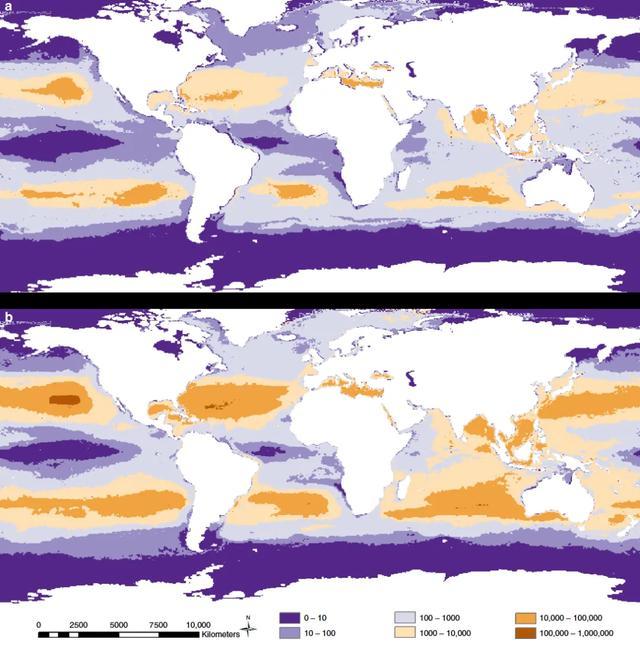
Global plastic exposure risk map of zooplankton: on the top, ingestable plastic density / plankton density; on the bottom, total plastic density / plankton density
It can be seen from the figure that, on a global scale, the East China Sea and the South China Sea, the bay of Bengal, the Black Sea, the Mediterranean Sea, the Sargasso Sea and the European coastline of the North Atlantic all belong to high-risk areas exposed to plastic pollution by plankton populations, and their ecological impacts need to be evaluated first.
In general, this is a very interesting paper, which belongs to the current popular data-driven research. The data in this paper are all from web of science and other databases, with a total of more than 20000 data, which belong to meta-analysis rather than laboratory research.
With the acceptance of data sharing and reuse in the academic community, more and more such articles will be published, and we can also see information from different perspectives.
However, there are some regrets that this article does not explain the reasons for this relationship in depth. Due to the nature of data-driven research, it is impossible to coordinate the differences between research and get more in-depth conclusions. For example, the relationship between the size of feeding system and plastic, the dynamics of degradation process of different plastic components after feeding, and the relationship between the intake and the distribution of plastic in the environment.
And these are all lacking at present. We would like to see follow-up studies to help understand the actual risks of plastic pollution from the perspective of biological metabolism.
Current hot spot: the impact of microplastics on the environment
However, in the field of environmental science, the recent research focus is actually micro plastics. It is also involved in this paper: if the longest size of plastic is replaced by the shortest size, it will be found that animal size does not fully explain the intake of small size plastic. This may be the starting point of this paper, but the correlation between the longest size and the size of animals was inadvertently found in the research.
So what are the risks of micro plastics to the environment? Of course, there is no question of whether we can eat or not, but how much we can eat and what will happen after eating.
As early as 2017, professor Allen Burton of the University of Michigan published a comment on the top journal Environmental Science and Engineering in the field of environment, throwing cold water on the research of microplastics. He believed that the current research of microplastics focuses too much on the distribution of the environment and lacks of risk research. For example, there are many dead branches and rotten leaves in the environment. If there is no harm, we should not invest too much energy. However, the specific impact and risk assessment of microplastics on organisms have been lack of research.
An interesting phenomenon is that the media like this kind of news very much, and policy makers are also affected by it. For example, it is forbidden to drop the micro bead industry that may produce micro plastics. In fact, the main source of micro plastics is polymer fiber or debris. In addition, professor Allen Burton believes that the greater harm may not be micro plastics, but nano plastics / nano particles with smaller scale.

Micro beads are banned, which has a certain impact on cosmetics, clothing and other industries
It should be noted that microplastics, like fine particles in the atmosphere, are pollutant carriers defined according to the scale. The harmful may be the particle size effect of the particles themselves, or the small pollutant molecules loaded or adsorbed on them.
In the past three years, micro plastics research has been carried out. The research team from China tested the plastic fiber in sea salt, lake salt and well salt, and found that the micro plastic in sea salt was significantly more than that in well salt. This perspective is unique and directly linked to food, but there is still a lack of risk assessment.
A review in 2018 pointed out that polyethylene plastics are more likely to absorb pollutants than other types of micro plastics.
A more macro survey found that only 7% of the world's plastics are recycled, while Asia, especially China, has basically no good control. 90% of the world's marine micro plastics are imported from 10 major rivers, 8 of which are from Asia, especially the Yangtze River.
In response to professor Allen Burton's article that there is no evidence for the toxicity of plastics, German scientists sent a response. Although the toxicity data is lacking, they can't wait for the problem to be solved. There seems to be only one reasonable solution: modeling.
At the same time, as a cutting-edge research direction, at the beginning of the micro plastic classification standards are not unified. Later, for a large class of pollutants represented by plastic fiber, some people can't sit down and unify the standards. This is a mature performance of problem research.
With the deepening of research, the concept of marine microplastics has also evolved. Last year (2019), someone proposed a new concept of environmental geochemical cycle: global scale plastic cycle, which means that the previous research paradigm of carbon and nitrogen cycle may shift to carry out more systematic research.
Media reports on micro plastics in tap water also make the public gradually pay attention to this field. It has been found that the exposure of microplastics in drinking water is much higher than that in tap water; however, there are disinfection by-products in tap water. To put it bluntly, is it the right to take the light of two evils, or use a glass bottle?

Micro plastic exposure in bottled water is much higher than that in tap water
In terms of risk research, the researchers found that the physical and chemical properties of the soil added with micro plastics would change, and plant growth and Rhizosphere organisms would also be affected, suggesting that in addition to the impact on aquatic ecology, terrestrial ecology or agriculture would also have an impact.
In a word, researchers have done a lot of work on microplastics from revealing environmental exposure level to studying its harm, but we have to admit that the conclusive epidemiological evidence is not sufficient at present, but as a carrier of pollutants, microplastics at the logical level does have risks.
And I believe that micro plastics are the most eaten by marine organisms.