The Organisation for Economic Co-operation and Development (OECD) has warned that if nothing is done, global plastic consumption will nearly triple from 460 million tonnes to 1.231 billion tonnes in 2060 compared to 2019, while waste plastic will increase by the same proportion, from 353 million tonnes to 1.014 million tonnes.
If global action is taken, the OECD estimates that the amount of plastic waste will fall from an estimated 1,014 million tonnes to 679 million tonnes, with recycling rates rising to 60%.
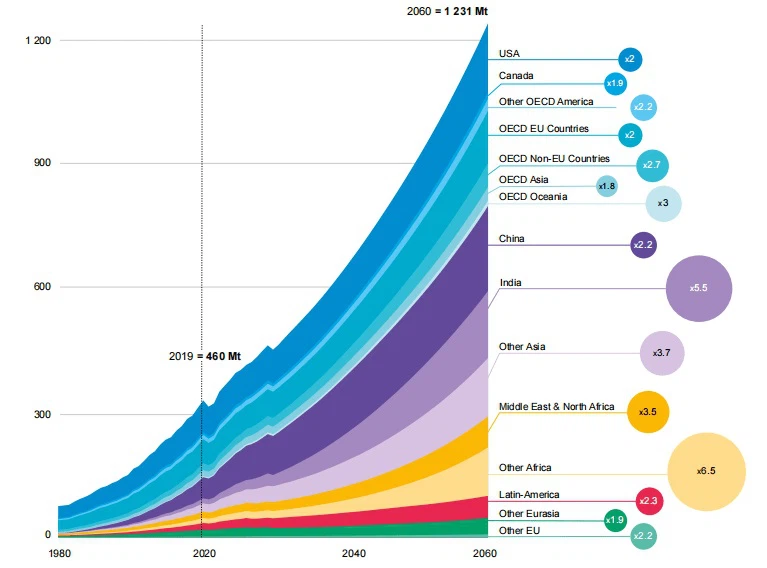
Emerging economies in Asia and sub-Saharan Africa are expected to see the fastest growth in plastic use
Global Plastics Outlook: Policy scenarios to 2060
The OECD has released a preliminary version of its Global Plastics Outlook: Policy Scenarios to 2060, which shows that plastic waste has doubled in the past decade and that without radical action to curb demand, extend product life, improve waste management and recyclability, plastic pollution will rise rapidly along with population and income growth. The report estimates that by 2060, nearly two-thirds of plastic waste will come from short-term products such as packaging, low-cost products and textiles.
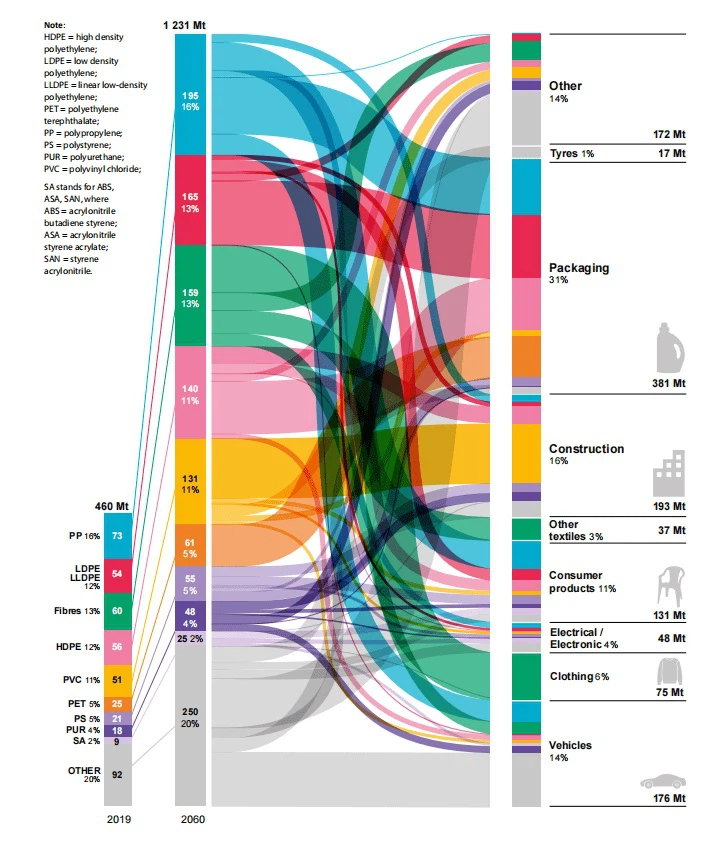
The use of all plastics is expected to increase significantly by 2060
OECD experts predict a significant increase in plastic waste by 2060 in rich countries, especially in the United States and Europe. In developed countries, per capita plastic waste in 2060 will reach 238 kg/year, three times the average in other regions (77 kg).
By 2060, about half of global plastic waste will end up in open or exposed landfills, 20% will be incinerated, and only 17% will be recycled. It is estimated that 15% of waste plastic will pose a threat to the natural environment in landfills and surrounding areas. While that number is down from the current 22%, it is still at a very high level.
Global action will reduce usage and waste by a third
Under the mandate of the negotiating parties to the international treaty, the OECD is evaluating two options for reducing plastic waste, with varying degrees of enhanced measures covering the entire life cycle of plastic production, use, recycling or disposal.
The regional action policy scenario reflects regionally differentiated participation, with OECD countries having more ambitious goals than non-OECD countries. The Global Action Scenario explores a very stringent set of policies aimed at reducing global plastic leakage to near zero by 2060.

Policies that target different life cycle stages can significantly reduce the rate of change in the annual value of plastics to the environment, measured in megatons (Mt), compared to the baseline.
To significantly increase recycling rates, coordinated global action is needed to stop waste plastics leaking into the environment. For example, the United Nations Environment Assembly on developing a legally binding agreement on plastic pollution, the G20 Osaka Blue Ocean Vision, voluntary industry action, etc.
Global action could reduce the amount of plastic used and discarded by about a third compared to the "baseline" : by 2060, plastic use would fall from 1.231 million tonnes in the baseline scenario to 827 million tonnes. Due to the suppression of plastic demand and production, the amount of plastic waste will also be from the baseline scenario of 1.014 billion tons. That's down to 679 million tons. The recovery rate rose to 60%. Due to important demand-driven industry policies, such as increasing recycled ingredient content targets, the market share of recycled plastics will surge to 41% by 2060.